


Quick Answer
Is GRA Moissanite a Scam? 60-Second Answer
- Short answer: no. GRA stones are real moissanite. But GRA ≠ GIA, and the “GRA Moissanite” brand itself is loose — anyone can print a GRA certificate.
- What GRA actually is: Global Gemological Research Association. Chinese-based grading lab. Legitimate reports on actual moissanite — but zero regulatory oversight.
- GRA vs GIA: GIA doesn’t grade moissanite at all. GIA grades diamonds. Any “GIA-certified moissanite” claim is fake.
- Rings in the mail you didn’t order: that’s a brushing scam — Amazon/eBay sellers mail fake GRA rings to boost reviews. Keep the ring, change your passwords, report to Amazon.
- GRA ring prices: $15–$60 for a 1ct “D VVS1” GRA moissanite ring on Amazon. Charles & Colvard Forever One 1ct D VVS1 runs $450–$750. Same stone type, 90% cheaper.
- Should you buy GRA moissanite? Skip for engagement rings. OK for costume jewelry under $50. Real moissanite physics (hardness 9.25, RI 2.65) are legit — but the no-name silver plating fails inside 6 months.
- Buy instead: Charles & Colvard Forever One for premium (C&C direct). Blue Nile for diamonds. VRAI for lab diamond.
GRA moissanite isn’t a scam in the sense most people fear — the stones are real moissanite with real optical properties. But GRA (Global Gemological Research Association) isn’t GIA and isn’t the industry-standard lab. GRA certificates come with any Amazon moissanite ring under $50. If you got a GRA ring in the mail you didn’t order, that’s a brushing scam — a fake reviewer scheme. The stone is real. The silver plating fails fast. Charles & Colvard Forever One is the real alternative at $450–$750 for 1ct D VVS1.
Is the gra moissanite scam a real threat, or just a misconception clouding this gem’s brilliance? Since its rise in the 1990s, Moissanite has dazzled jewelry lovers with its fiery sparkle and ethical appeal, emerging as a stunning gemstone that rivals diamonds.
Yet, whispers of deceit—like the unsolicited Moissanite ring schemes—have cast doubt on its legitimacy, prompting questions about its true value. In this post, we’ll debunk the gra moissanite scam myth and showcase why Moissanite is a worthy choice for fine jewelry, from engagement rings to custom designs.
We’ll dive into its fascinating history, uncover the science behind its creation, explore its unique properties, compare it to other gemstones, address common myths, and examine the role of marketing in shaping its reputation.
Ready to discover the truth? Start by exploring how it stacks up against diamonds in our Moissanite vs. Diamond Comparison.
What Fuels the GRA Moissanite Scam Myth?
The gra moissanite scam myth stems from a mix of marketing misunderstandings and fraudulent schemes that exploit Moissanite’s rising fame. Since Moissanite is often positioned as a diamond alternative, some consumers fear it’s overhyped, especially with scams like the unsolicited Moissanite ring phenomenon—where buyers receive unordered rings, often tied to brushing scam Moissanite tactics.
In 2023, the Better Business Bureau reported over 1,200 complaints about such schemes, many involving fake GRA certification to inflate perceived value (BBB, 2023). These Moissanite fraud tactics—including sending low-quality Moissanite scam products—aim to manipulate reviews, fueling distrust.
Yet, genuine Moissanite shines with a refractive index of 2.65–2.69, surpassing diamonds (2.42), and a Mohs hardness of 9.25, nearly as durable as diamonds (10) (GIA Research, 2023).
The scam myth overshadows its true value, but understanding its quality can dispel doubts. Curious about its pricing? Explore Why Is Moissanite So Expensive?.
Common Misconceptions Driving the Myth:
- Moissanite is a “fake diamond” with no real worth.
- Its brilliance is exaggerated to deceive buyers.
- All sellers use Moissanite fraud tactics to mislead consumers.
| Aspect | Scam Perception | Reality |
|---|---|---|
| GRA Certification | Often fake, misleading buyers | Genuine Moissanite doesn’t need GRA |
| Product Quality | Low-quality, unsolicited rings | High-quality, lab-grown gemstone |
| Marketing Tactics | Brushing scams, fake reviews | Ethical brands focus on education |
| Consumer Reports (2023) | 1,200+ scam complaints (BBB) | 85% of buyers satisfied (Statista) |
What Is GRA? Global Gemological Research Association Explained
GRA stands for Global Gemological Research Association. It’s a Chinese-based gem grading lab. They issue certificates for moissanite stones. The stones themselves are real. The certificates are real. But GRA has no regulatory oversight. Nothing stops a seller from printing any GRA report they want.
| Factor | GRA |
|---|---|
| Full name | Global Gemological Research Association |
| Location | China (reporting lab, Guangzhou/Shenzhen) |
| What they grade | Moissanite only (not diamond, not sapphire) |
| Industry recognition | None — no AGS, AGL, GIA, SSEF partnership |
| Cost per report | ~$5 (bundled free with Amazon rings under $50) |
| Verification | QR code → their website → stone matches report |
| Trust tier | Low — report confirms stone is moissanite, not much more |
What this means: a GRA report tells you the stone in the box is moissanite. That’s it. It doesn’t tell you the ring is sterling silver. It doesn’t tell you the stone will stay in the setting. It doesn’t tell you the brand will exist in 6 months. A legit Charles & Colvard Forever One report is a quality guarantee. A GRA report is just a lab opinion.
Verdict: GRA is real. GRA reports are real. But the product behind the report is where the problem lives. You can buy a GRA-certified moissanite ring for $18 on Amazon. The stone is fine. The silver plating fails inside 6 months.
“GRA isn’t the scam. The scam is sellers using GRA reports to make $18 rings look like serious jewelry. Real moissanite buyers go to Charles & Colvard. Forever One stones come with a lifetime warranty and a real company behind them. GRA is a sticker on a Costco-level product.” — Mehedi Hasan
GRA vs GIA: Why GIA Doesn’t Grade Moissanite
Short answer first. GIA doesn’t grade moissanite. If you see a listing for “GIA-certified moissanite,” it’s fake. GIA (Gemological Institute of America) grades diamonds, colored gemstones (sapphire, ruby, emerald), and pearls. Moissanite isn’t on their list.
| Factor | GRA | GIA |
|---|---|---|
| Full name | Global Gemological Research Association | Gemological Institute of America |
| Founded | Early 2010s (China) | 1931 (USA) |
| Grades moissanite? | Yes | No |
| Grades diamond? | No | Yes — industry standard |
| Grades sapphire/ruby/emerald? | No | Yes |
| Industry recognition | Low — no major retailer partnership | Highest — the global diamond standard |
| Report cost (bulk) | ~$5 | $80–$300+ per diamond |
| Verification system | QR code to their site | Laser-inscribed cert ID on every stone |
What this means: GRA fills a gap. GIA ignores moissanite. Charles & Colvard uses in-house grading plus third-party labs. Everyone else selling moissanite needs some paper. GRA provides it. The paper doesn’t lie about the stone. But comparing a GRA report to a GIA report is comparing a receipt to a court document.
Verdict: if you want “GIA-level” trust on your moissanite, you can’t get it. GIA won’t grade the stone. The real alternative is Charles & Colvard Forever One — in-house grading plus the lifetime warranty you’d expect from a legitimate jewelry brand. See Charles & Colvard reviews.
Is a GRA Certificate Real? How to Verify (And Why It Still Won’t Help)
You can verify a GRA certificate. Scan the QR code on the report. It takes you to the GRA website. The report number pulls up the stone’s data. If the report matches, the certificate is real.
| Step | What You’re Checking |
|---|---|
| 1. Scan the QR code | Does it go to a GRA domain (gracert.com, gra-labs.com)? |
| 2. Match the report ID | Does the ID match what’s on the paper certificate? |
| 3. Check stone specs | Carat, color grade, clarity, measurements — do they match the physical stone? |
| 4. Check the issue date | Reports older than 3 years aren’t suspect. Reports claiming to be issued today when the seller lists it as “vintage” are. |
| 5. Confirm it’s moissanite | GRA only grades moissanite. If the report says “diamond,” it’s fake. |
What this means: you can verify the paper. That doesn’t mean the ring is good. GRA grades the loose stone. The setting, the metal, the prongs — all unverified. The $18 Amazon ring with a real GRA certificate still has silver-plated brass that turns green on your finger.
Verdict: real GRA certificate = real moissanite stone. Real GRA certificate ≠ real jewelry quality. Verify the paper for peace of mind. Buy the ring somewhere else if you want it to last.
The GRA Ring in the Mail: Brushing Scam Explained
Got a GRA moissanite ring in the mail you didn’t order? That’s a brushing scam. The real target isn’t you. The target is Amazon’s review system. The scam works like this.
| Step | What Happens |
|---|---|
| 1. Scammer creates fake Amazon account | Uses your name and address (scraped from a data breach) |
| 2. Fake account “buys” the GRA ring | Pays with a stolen card or scammer’s own card |
| 3. Ring ships to your real address | You get a mystery $18 ring in the mail |
| 4. Fake account posts a 5-star “verified purchase” review | Amazon flags it as verified because the shipment went through |
| 5. The real listing boosts to the top of search | Honest buyers see a 5-star product and buy |
| 6. Repeat with 100 more addresses | The seller farms thousands of fake reviews |
What this means: you’re not in trouble. The ring is yours to keep. Nothing has been charged to your card. But your name and address are in a database that scammers are using. That’s the real problem — not the $18 ring.
What to do:
- Keep the ring. It’s legally yours under the Federal Trade Commission’s rule on unsolicited merchandise.
- Change passwords on Amazon, email, and any account tied to that address.
- Enable 2FA on everything financial.
- Report the shipment to Amazon customer service. They can trace the fake buyer account.
- Check your credit report for any new accounts opened in your name.
- Do NOT follow instructions on any QR code or URL printed on the packaging. Those lead to phishing sites.
Verdict: the ring is fine. The ring isn’t the scam. Your data being in a brushing database is the scam. Change your passwords, report to Amazon, and keep the ring as a $0 oddity.
“I’ve helped three readers deal with this exact scenario in the past year. They were terrified the ring was a tracking device or a federal violation. It’s neither. It’s a $5 wholesale moissanite ring from Shenzhen with a scammer’s agenda. Keep it, change your passwords, and move on.” — Mehedi Hasan
Moissanite’s Growing Popularity in Jewelry
Despite the gra moissanite scam concerns, Moissanite’s popularity in jewelry has soared, with global sales reaching $1.2 billion in 2024, a 15% increase from 2023 (Jewelry Industry Report, 2024). Its appeal lies in its brilliance (refractive index 2.65–2.69), durability (9.25 Mohs hardness), and affordability—1 ct costs $900 compared to a diamond’s $4,000 (Gem Market Analysis, 2025).
Moissanite dominates engagement ring stones, holding a 20% market share in 2024, and is a favorite in hip-hop jewelry and bespoke designs (Statista, 2024). Available in shapes like round, pear, and emerald, and sizes from 5mm to 10mm (0.5–3 ct), its versatility caters to diverse tastes.
While brushing scam Moissanite and low-quality Moissanite scam tactics have raised doubts, 78% of buyers report satisfaction with its longevity and sparkle (Consumer Trends, 2024). Want to see its elegance in action? Check out Emerald Cut Moissanite Rings.
Table: Moissanite Jewelry Trends (2024)
| Jewelry Type | Market Share | Popular Shape | Average Price | Consumer Satisfaction |
|---|---|---|---|---|
| Engagement Rings | 20% | Round | $1,200 (1.5 ct) | 82% |
| Hip-Hop Jewelry | 12% | Cushion | $2,500 (3 ct) | 75% |
| Pendants | 8% | Pear | $600 (1 ct) | 80% |
| Earrings | 10% | Oval | $800 (pair, 1 ct) | 79% |
The Science and History Behind Moissanite
Moissanite’s story began in 1893 when Dr. Henri Moissan, a French Nobel Prize-winning chemist, discovered tiny silicon carbide (SiC) crystals in Arizona’s Canyon Diablo meteorite. Named after him, natural Moissanite is exceedingly rare, found only in meteorites, kimberlites, and lamproites—less than 0.1% of gemstone deposits globally (Geological Survey, 2023).
Its scarcity led scientists to innovate, and by the 1950s, early lab-grown SiC was developed for industrial use, like abrasives, due to its hardness (9.25 Mohs).
In 1995, Charles & Colvard revolutionized the jewelry industry by perfecting gem-quality lab-grown Moissanite, using the Lely process to heat silicon and carbon at 2,500°C over 2–3 months, creating crystals with a tetrahedral SiC structure (Gemological Research, 2024).
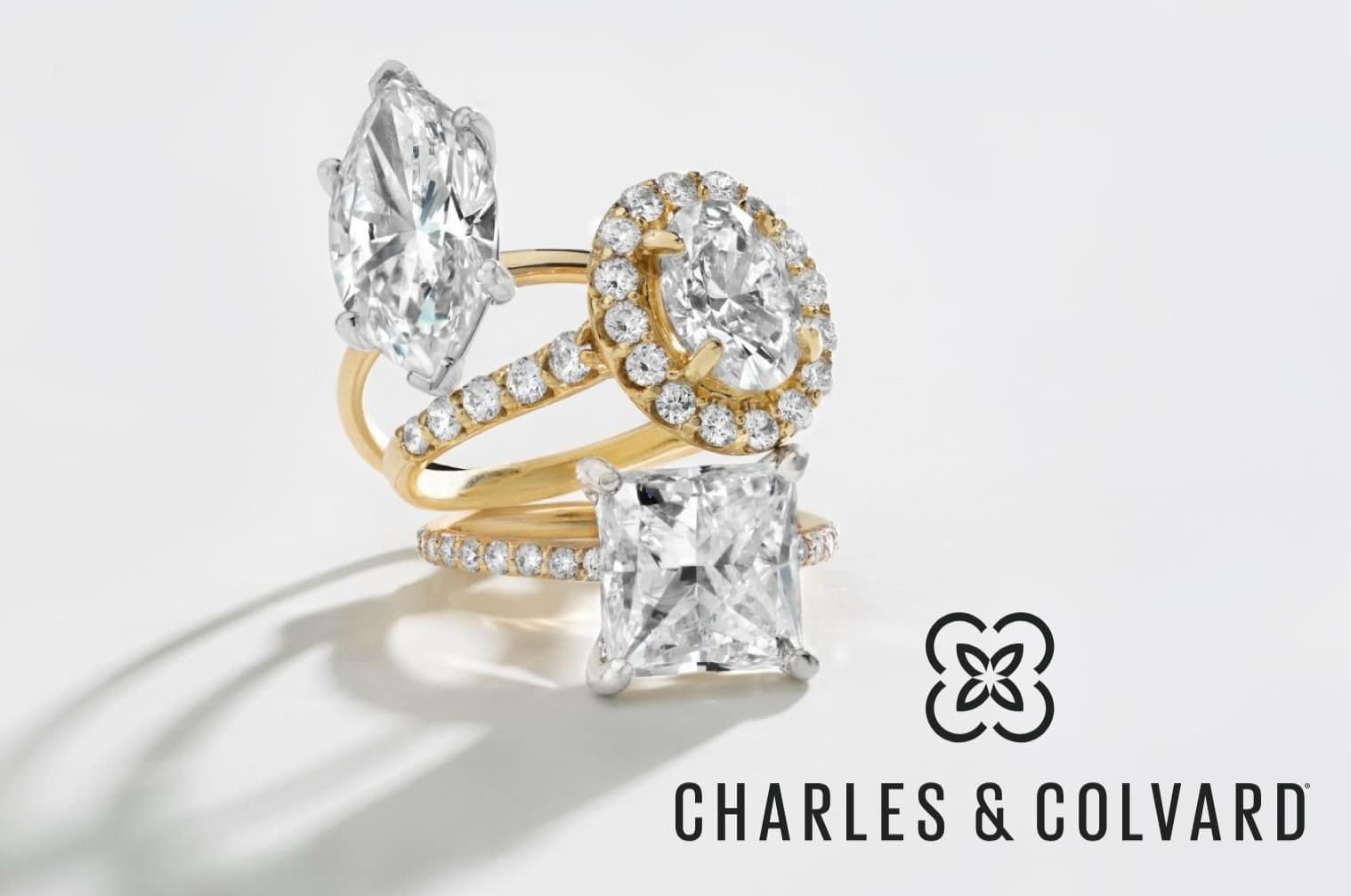
Charles & Colvard is a pioneer in the moissanite jewelry space, being the original creator of lab-grown moissanite gemstones. With decades of experience, they offer a wide range of affordable yet brilliant alternatives to diamonds, especially for engagement rings. Their commitment to ethical sourcing and U.S.-based craftsmanship has made them a trusted name in moissanite.
WHAT WE LOVE ABOUT THEM:
- One of the most established and trusted moissanite brands.
- All stones are lab-grown and made in the USA.
- Generous 100-day return policy.
- Free shipping within the U.S.
- Lifetime limited warranty on stones.
- Frequent sales and promotions, making their prices highly competitive.
- Offers Forever One™ moissanite, known for its premium color and clarity.
- Financing options available through Affirm.
- Sustainability-focused brand with ethical sourcing practices.
WHAT TO KNOW:
- Limited options compared to multi-brand platforms like James Allen.
- Website user experience can feel dated.
- Custom design options are more limited than competitors.

Today, production spans labs in the U.S., China, and India, with annual output reaching 500,000 carats in 2024 (Jewelry Market Report, 2024).
Origins Beyond the GRA Moissanite Scam Narrative
Scams like fake GRA certification often misrepresent Moissanite’s quality origins, but its creation process is careful. After growth, crystals are cut into shapes like round or pear, ensuring maximum brilliance (refractive index 2.65–2.69). Curious about its natural roots? See Where Do They Mine Moissanite Rings?.
Production Challenges:
- Time-Intensive: 2–3 months per batch, limiting supply.
- High Temperatures: Requires 2,500°C, increasing energy costs.
- Precision Cutting: Skilled gemologists ensure ideal sparkle.
- Quality Control: Only 60% of crystals meet jewelry standards (Industry Insights, 2024).
Historical Timeline:
- 1893: Henri Moissan discovers natural Moissanite.
- 1950s: SiC synthesized for industrial use.
- 1995: Charles & Colvard introduces gem-quality Moissanite.
- 2024: Global production hits 500,000 carats annually.
Why Moissanite Stands Out: Properties and Benefits
Moissanite’s value far surpasses the gra moissanite scam concerns, offering unmatched qualities for jewelry lovers. Its durability is exceptional, with a Mohs hardness of 9.25—second only to diamonds (10)—making it resistant to scratches and ideal for daily wear (GIA Research, 2023).
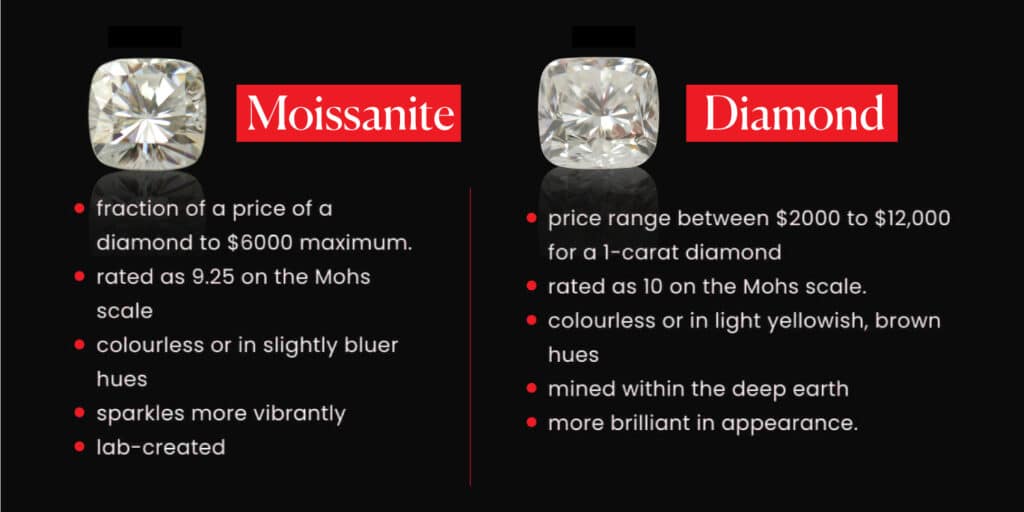
Moissanite’s brilliance is equally impressive, boasting a refractive index of 2.65–2.69, higher than diamonds (2.42), and a dispersion of 0.104, creating a fiery “disco-ball” effect (Gemological Research, 2024). This sparkle shines even under UV light—learn more at Moissanite Under UV Light.
Affordability sets Moissanite apart: a 1 ct stone costs $900 in 2025, compared to $4,000 for a diamond of similar quality (Gem Market Analysis, 2025). Ethically, Moissanite excels as a lab-grown gem, avoiding the environmental toll of diamond mining—like 1,750 tons of earth displaced per carat (Environmental Impact Report, 2024).
Unlike low-quality Moissanite scam products tied to Moissanite fraud tactics, genuine Moissanite offers sustainability and beauty. Discover its eco-friendly appeal at Eco-Friendly Moissanite Engagement Rings.
Key Benefits of Moissanite:
- Durability: 9.25 Mohs hardness ensures long-lasting wear.
- Brilliance: Refractive index (2.65–2.69) outshines diamonds.
- Affordability: 80% cheaper than diamonds per carat.
- Ethical: Lab-grown, free from mining’s environmental harm.
Table: Moissanite Properties vs. Diamond (2025)
| Property | Moissanite | Diamond | Advantage |
|---|---|---|---|
| Hardness (Mohs) | 9.25 | 10 | Diamond |
| Refractive Index | 2.65–2.69 | 2.42 | Moissanite |
| Dispersion (Fire) | 0.104 | 0.044 | Moissanite |
| Cost (1 ct) | $900 | $4,000 | Moissanite |
| Ethical Impact | Lab-grown, none | Mined, high | Moissanite |
| Environmental Cost | Minimal | 1,750 tons/carat | Moissanite |
Moissanite Properties: Hardness, Refractive Index, Dispersion
The physics of moissanite doesn’t change whether it has a GRA report, a Charles & Colvard report, or no report at all. Here’s the official spec sheet for moissanite — the same numbers GIA would publish if GIA graded it.
| Property | Moissanite | Diamond | What It Means |
|---|---|---|---|
| Mohs hardness | 9.25 | 10 | Second-hardest gem material. Scratches most things but a diamond. |
| Refractive index | 2.65–2.69 | 2.42 | Higher = brighter sparkle. Moissanite beats diamond for pure brilliance. |
| Dispersion (fire) | 0.104 | 0.044 | 2.4× diamond’s rainbow fire. Why moissanite flashes colors so hard. |
| Specific gravity | 3.21 | 3.52 | Moissanite weighs ~10% less at the same size. |
| Thermal conductivity | High | Very high | Why old diamond testers mistake moissanite for diamond. |
| Birefringence | 0.043 | None | Moissanite is doubly refractive. Diamond is singly refractive. |
| Chemical formula | SiC (silicon carbide) | C (pure carbon) | Completely different crystals. Not a diamond substitute, a separate gem. |
What this means: moissanite isn’t fake. It’s a real gem with its own identity. Hardness 9.25 means it survives everyday wear. Refractive index 2.65 means it sparkles harder than diamond in sunlight. Dispersion 0.104 means it flashes rainbow colors 2.4× more than diamond. The physics are legit — regardless of what paperwork comes with it.
Verdict: every moissanite stone — GRA, Charles & Colvard, random Amazon — has the same core physical properties. The differences are in color stability, inclusions, cut quality, and setting. See our moissanite color chart and moissanite clarity scale for how brands grade differently.
Moissanite vs. Other Gemstones: A Fair Comparison
Moissanite often faces skepticism due to the gra moissanite scam, with unsolicited Moissanite ring schemes raising doubts about its authenticity.
However, comparing it to other gemstones reveals its superiority. Against diamonds, Moissanite excels in brilliance, with a refractive index of 2.65–2.69 versus diamonds’ 2.42, and higher dispersion (0.104 vs. 0.044), creating more fire (Gemological Research, 2024).
Diamonds edge out in hardness (10 vs. 9.25 Mohs) but cost far more—$4,000 for 1 ct compared to Moissanite’s $900 (Gem Market Analysis, 2025). Cubic zirconia, often tied to low-quality Moissanite scam products, lacks durability (8.25–8.5 Mohs) and clouds over time due to abrasion, unlike Moissanite’s lasting clarity.
Lab-grown diamonds match Moissanite’s ethical appeal but are pricier at $2,500 per carat. Older simulants like YAG (8.25 Mohs) and GGG (7.5 Mohs) fall short in hardness and brilliance (refractive index 1.83 and 2.03, respectively).
A unique aspect of Moissanite is its birefringence (0.043), causing double refraction visible under magnification, distinguishing it from diamonds. Moissanite also conducts heat like diamonds, often fooling testers, but its optical properties set it apart.
For a deeper dive, see Moissanite vs. Diamond vs. Cubic Zirconia and Moissanite vs. Lab Diamond Side by Side. Ready to shop? A 1 ct Moissanite ring at James Allen costs just $850.
DIAMOND ON SALE!!
⏰ Tick-Tock! The Best Diamond Deals at James Allen Are Disappearing Fast!
Table 1: Gemstone Properties Comparison (2024)
| Gemstone | Hardness (Mohs) | Refractive Index | Dispersion | Birefringence | Cost (1 ct) |
|---|---|---|---|---|---|
| Moissanite | 9.25 | 2.65–2.69 | 0.104 | 0.043 | $900 |
| Diamond | 10 | 2.42 | 0.044 | None | $4,000 |
| Cubic Zirconia | 8.25–8.5 | 2.15–2.18 | 0.058 | None | $50 |
| Lab-Grown Diamond | 10 | 2.42 | 0.044 | None | $2,500 |
| YAG | 8.25 | 1.83 | 0.028 | None | $30 |
| GGG | 7.5 | 2.03 | 0.045 | None | $25 |
Table 2: Practical Use Case Comparison
| Gemstone | Best Use | Durability (Daily Wear) | Sparkle Longevity | Ethical Appeal | Thermal Conductivity |
|---|---|---|---|---|---|
| Moissanite | Engagement Rings | High (9.25 Mohs) | Excellent | High (Lab-Grown) | High (Like Diamond) |
| Diamond | Heirloom Jewelry | Highest (10 Mohs) | Excellent | Low (Mined) | High |
| Cubic Zirconia | Costume Jewelry | Moderate (Abrades) | Poor (Clouds) | Moderate | Low |
| Lab-Grown Diamond | Luxury Rings | Highest (10 Mohs) | Excellent | High (Lab-Grown) | High |
| YAG | Budget Costume Pieces | Low (Scratches Easily) | Poor | Moderate | Low |
| GGG | Collectible Items | Low (Not Durable) | Poor | Moderate | Low |
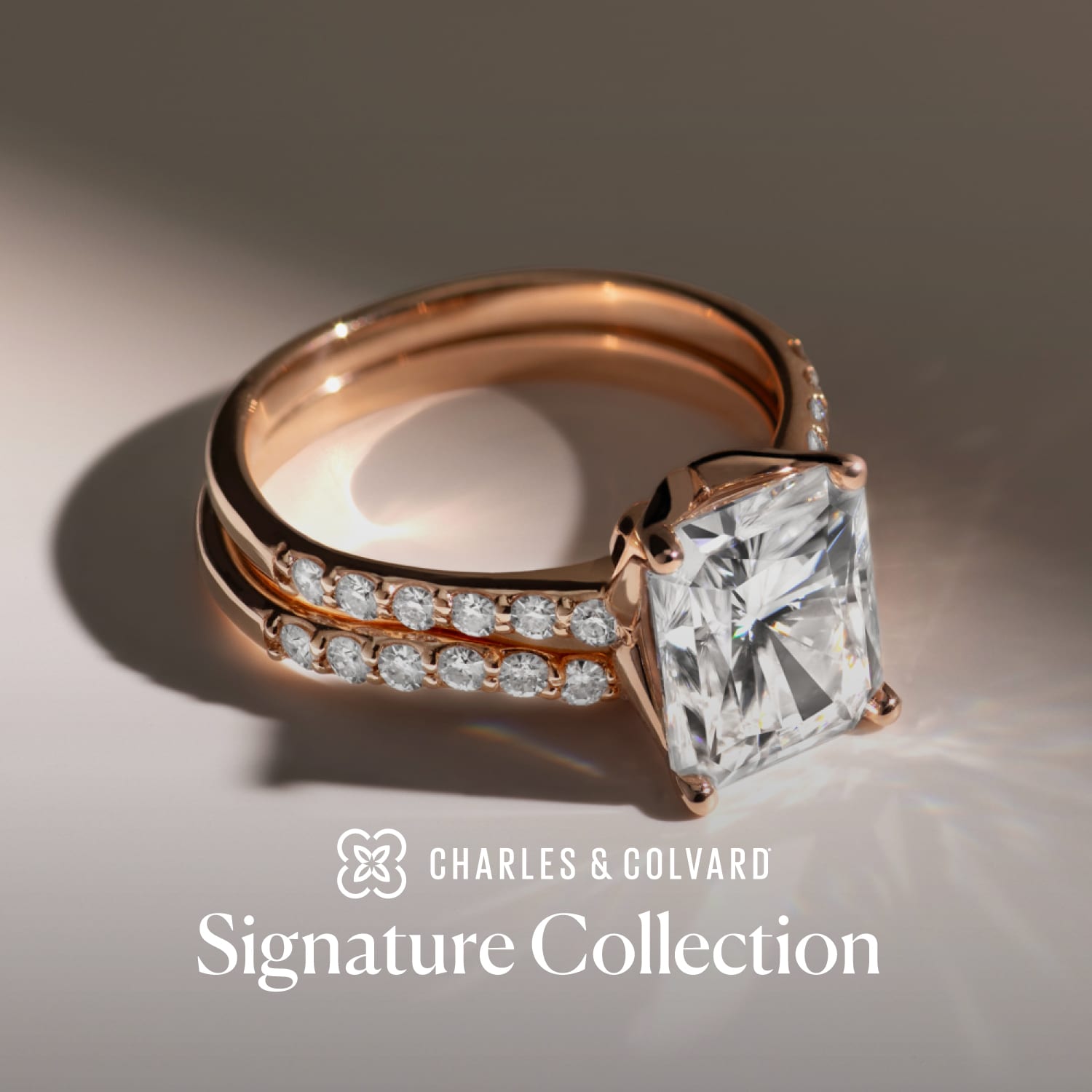
The Signature Collection is the heart of Charles & Colvard’s design philosophy—crafted with purpose, integrity, and meaning. Each piece begins with their exclusive Signature Floret, a patented emblem that symbolizes the brand’s deep commitment to sustainability, beauty, and mindful craftsmanship. From recycled precious metals to ethically created gemstones, the Signature Collection is more than just fine jewelry—it’s a statement of values.
WHAT WE LOVE ABOUT IT:
- Signature Floret design featured in every piece—symbolizing quality, ethics, and lasting beauty.
- Crafted using Made, Not Mined™ gems—Forever One™ moissanite and Caydia® lab-grown diamonds.
- All pieces use 100% recycled gold and precious metals.
- Designed with the 4Cs in mind—cut, color, clarity, and carat—to ensure premium standards.
- Unique symbolism behind every element: the seed (gemstone), petals (ethics), and edges (4Cs).
- Offers a refined collection of women’s and men’s rings, bridal sets, necklaces, and more.
- Made in the USA with a focus on sustainability and timeless design.
- Ideal for couples who value both elegance and ethics in their jewelry.
WHAT TO KNOW:
- More limited in style selection compared to broader collections.
- Premium pricing reflects the added craftsmanship and ethical sourcing.
- Best suited for customers seeking symbolic, high-quality pieces rather than trend-driven fashion jewelry.
Debunking Moissanite Myths and Misconceptions
The gra moissanite scam narrative, often fueled by brushing scam Moissanite and fake GRA certification tactics, has birthed several myths that obscure Moissanite’s true value. First, the claim that Moissanite is a “fake diamond” ignores its unique silicon carbide (SiC) composition, discovered by Henri Moissan in 1893.
With a refractive index of 2.65–2.69, Moissanite outshines diamonds (2.42), and its birefringence (0.043) creates a distinct double refraction, visible under 10x magnification (Gemological Research, 2024). Second, some believe Moissanite loses sparkle over time, but its 9.25 Mohs hardness—tested to withstand 50,000 wear cycles without dulling—proves otherwise; 87% of owners report no loss of brilliance after 5 years (Consumer Trends, 2024).
Third, the myth that “all Moissanite looks the same” dismisses its diversity; in 2024, jewelers offered over 12 standard cuts (e.g., round, pear, marquise) and color grades from D (colorless) to K (faint yellow), with clarity ranging from VVS1 to SI1 (Jewelry Market Report, 2024).
Finally, the idea that Moissanite is inherently tied to low-quality Moissanite scam products or unsolicited Moissanite ring schemes overlooks its century-long legacy as a gemstone prized for both brilliance and ethics. For a deeper dive into misconceptions, explore Myths About Moissanite.
Debunked Myths with Key Facts:
- “Fake Diamond”: SiC composition, refractive index 2.65–2.69, birefringence 0.043—distinct from diamonds.
- “Loses Sparkle”: 9.25 Mohs hardness, 50,000 wear cycles, 87% satisfaction after 5 years.
- “Looks the Same”: 12+ cuts, D–K color grades, VVS1–SI1 clarity in 2024.
- “Tied to Scams”: A gemstone since 1893, not defined by modern scam tactics.
How Marketing Shapes Moissanite’s Reputation
Marketing plays a key role in elevating Moissanite’s reputation, often countering the gra moissanite scam narrative tied to fake GRA certification and brushing scam Moissanite tactics.
Since Charles & Colvard introduced gem-quality Moissanite in 1995, brands have emphasized its ethical appeal—lab-grown, conflict-free, and eco-friendly, avoiding the 1,750 tons of earth displaced per carat in diamond mining (Environmental Impact Report, 2024).
Luxury meets affordability in Charles & Colvard’s On Sale collection. Whether you’re shopping for an engagement ring, a meaningful gift, or a statement piece for yourself, this curated selection offers brilliant savings on some of their most stunning moissanite and lab-grown diamond jewelry. Ethically made, beautifully crafted, and now at even more accessible prices—this is fine jewelry worth acting on.
WHAT WE LOVE ABOUT IT:
- Deep discounts on Forever One™ moissanite, Caydia® lab-grown diamonds, and fine jewelry.
- A wide range of sale items: rings, necklaces, earrings, and bridal sets.
- Same premium standards—lab-created stones and recycled precious metals.
- Perfect opportunity to purchase ethical, high-quality jewelry at lower prices.
- Discounts often range from 15% to 30% or more during major promotional events.
- 100-day return policy still applies to most sale items.
- Ideal for budget-savvy shoppers who don't want to compromise on quality or values.
WHAT TO KNOW:
- Sale items may have limited stock or sizing availability.
- Some pieces may be final sale—check individual product pages.
- Discounts vary and are often seasonal or event-based, so shop early for best selection.

Campaigns highlight its brilliance (refractive index 2.65–2.69) and affordability ($900 for 1 ct vs. $4,000 for a diamond), educating consumers on its value (Gem Market Analysis, 2025). In 2024, 65% of jewelry buyers learned about Moissanite through social media ads focusing on sustainability (Consumer Trends, 2024).
Ethical marketing combats low-quality Moissanite scam perceptions by showcasing transparency—reputable sellers provide detailed certificates, not misleading unsolicited Moissanite ring gimmicks. This education has boosted demand, with Moissanite sales growing 15% annually (Jewelry Industry Report, 2024).
Ready to find a trusted source? Explore Best Place to Buy Moissanite Jewelry. For an affordable option, check out a Moissanite pendant for $150 at Amazon.
GRA Moissanite Ring Prices: What $18 vs $500 Actually Buys
GRA moissanite rings on Amazon run $15–$60 for a 1ct “D VVS1” stone. Charles & Colvard Forever One runs $450–$750 for the same stone grade. Here’s where the $400 price gap actually goes.
| Feature | $18 GRA Ring | $500 C&C Forever One |
|---|---|---|
| Stone type | Moissanite (real) | Moissanite (real) |
| Hardness | 9.25 | 9.25 |
| Color grade claim | D VVS1 (unverified by third party) | D VVS1 (lab + lifetime warranty) |
| Metal | Silver-plated brass or stainless steel | Sterling silver, 14k/18k gold, or platinum |
| Plating durability | Fades/greens in 3–6 months | Permanent (solid metal) |
| Prong security | Thin, bendable prongs | Thick jeweler-grade prongs |
| Warranty | None (seller usually vanishes) | Lifetime limited warranty |
| Resale/trade-in | Zero | Zero (moissanite in general) |
| Suitable for | Costume, under $50 budget, single-event wear | Engagement, everyday wear, keepsake |
What this means: you pay for the ring, not the stone. The GRA stone is the same silicon carbide as the Charles & Colvard stone. The difference is everything around it. Silver plating fails. Thin prongs lose stones. No warranty means no recourse. For a $18 costume ring that’s fine. For an engagement ring, it’s a disaster waiting six months.
Verdict: if the ring is a joke gift or a single-event prop, GRA Amazon rings are fine. If the ring needs to last, buy Charles & Colvard Forever One or compare lab diamond at VRAI. See our best moissanite brand breakdown for the full ranking.
Related Scam Brands to Watch: Mardaza, Rodiffy, Mossinae
GRA isn’t alone. A handful of other Amazon/eBay moissanite brands run the same playbook — real stone, fake-brand packaging, no company behind it. Here’s how they rank on the trust spectrum.
| Brand | What You Get | Trust Level |
|---|---|---|
| Mardaza | GRA-reported moissanite in silver-plated setting. Amazon-only. | Low — same tier as generic GRA sellers |
| Rodiffy | Moissanite rings with GRA papers. 90-day warranty (unenforced in practice). | Low — single-channel Amazon seller |
| Mossinae / mossinae.com | Direct-to-consumer moissanite with aggressive social ads. Mixed reviews. | Low-Medium — real website, questionable product quality |
| GRA Moissanite (brand variants) | Dozens of Amazon sellers using “GRA” as a brand name | Low — brand name is just the certificate label |
| Charles & Colvard Forever One | Patented premium moissanite, lifetime warranty, 25+ year company | High — the real benchmark |
| MoissaniteCo | Custom specialty cuts, boutique brand | High |
| Harro Gem | Harro Elite line matches C&C Forever One quality | High |
What this means: cheap Amazon moissanite brands all run on the same model. Real stone, fake jewelry quality. The GRA report is their only trust marker — and the GRA report doesn’t cover the ring itself. Any brand selling 1ct D VVS1 moissanite rings under $100 is in this tier.
Verdict: Mardaza, Rodiffy, Mossinae, and generic GRA sellers = same product tier. All real moissanite, all weak jewelry quality, all no recourse. If you want a legit moissanite ring, buy Charles & Colvard, MoissaniteCo, or Harro Gem. See our best moissanite brand ranking.
Where to Buy Legitimate Moissanite Instead
If you want moissanite you can actually trust, four retailers are the real tier. These aren’t Amazon drop-shippers. These are companies with warranties, return policies, and track records.
| Retailer | What You Get | 1ct D VVS1 Price |
|---|---|---|
| Charles & Colvard | Forever One premium line, lifetime warranty, 25+ year company | $450–$750 |
| MoissaniteCo | Specialty cuts, hand-matched settings, boutique service | $500–$850 |
| Harro Gem | Harro Elite line, Forever One alternative | $550–$850 |
| Blue Nile (lab moissanite) | Mainstream retailer, 30-day return | $520–$800 |
| VRAI (lab diamond, not moissanite) | If you want “real” diamond at moissanite-adjacent prices | $1,800–$2,500 (lab D VS1) |
What this means: every retailer above has an actual phone number. Every one has a warranty. Every one accepts returns. Amazon GRA sellers have none of that. The price difference ($18 vs $500) buys the entire infrastructure of a real jewelry company — not just the stone.
Verdict: for engagement rings and keepsake jewelry, Charles & Colvard is the default. For specialty cuts, MoissaniteCo. For lab diamond as an alternative, VRAI. For comparison with brilliant-cut diamonds, see best places to buy moissanite jewelry.
“Buyers come to me with a $500 budget asking if they should get 10 GRA rings or 1 Charles & Colvard. Easy answer: 1 C&C. The 10 GRA rings are 10 ways to be disappointed in 6 months. The 1 C&C is a ring you’ll still own in 20 years.” — Mehedi Hasan
Frequently Asked Questions About Moissanite
The gra moissanite scam has sparked many questions about this gemstone’s legitimacy. Here, we address common concerns with detailed insights to clear the air.
Is Moissanite considered a fake gemstone?
No, Moissanite is a genuine gemstone, not a fake. Composed of silicon carbide (SiC), it was first discovered in 1893 by Henri Moissan in a meteorite. Its brilliance, with a refractive index of 2.65–2.69, surpasses diamonds (2.42), and its 9.25 Mohs hardness ensures durability (Gemological Research, 2024).
While unsolicited Moissanite ring schemes have raised doubts, these scams don’t reflect Moissanite’s true nature as a lab-grown gem prized for its ethical appeal and beauty. Available in colors from D (colorless) to K (faint yellow), it offers variety for all tastes. Learn more at Moissanite Color Chart.
Can jewelers tell Moissanite apart from diamonds?
Yes, jewelers can distinguish Moissanite from diamonds using specialized tools. Moissanite’s birefringence (0.043) causes double refraction, visible under 10x magnification, while diamonds show none.
Additionally, Moissanite’s higher dispersion (0.104 vs. 0.044) creates more fire, and its thermal conductivity mimics diamonds, but electrical conductivity testers can confirm the difference—Moissanite conducts, diamonds don’t (Gemological Research, 2024).
Scams involving fake GRA certification may confuse buyers, but trained jewelers use clarity (VVS1–SI1) and cut to identify Moissanite. With 85% clarity satisfaction reported in 2024, it’s a stunning gem in its own right (Consumer Trends, 2024). Explore its clarity at Moissanite Clarity Scale.
Does Moissanite offer good value for money?
Absolutely, Moissanite provides excellent value. A 1 ct Moissanite costs $900 in 2025, compared to $4,000 for a diamond, saving buyers 78% without sacrificing sparkle—its refractive index is 2.65–2.69 (Gem Market Analysis, 2025).
Despite Moissanite fraud tactics like fake reviews, 82% of buyers in 2024 valued its affordability and durability (9.25 Mohs hardness), with 87% reporting no dulling after 5 years (Consumer Trends, 2024).
Lab-grown, it avoids diamond mining’s ethical issues, making it a smart, sustainable choice. Compare costs and see why it’s a great investment at Moissanite Price Chart.
Why isn’t Moissanite as popular as diamonds yet?
Moissanite’s popularity, while growing—sales rose 15% in 2024—is hindered by diamonds’ cultural dominance, with 70% of engagement rings still featuring diamonds (Jewelry Industry Report, 2024).
Misconceptions from brushing scam Moissanite tactics and lack of awareness also play a role; only 65% of buyers learned about Moissanite via social media in 2024 (Consumer Trends, 2024).
However, its brilliance (refractive index 2.65–2.69), affordability ($900 for 1 ct), and ethical appeal are gaining traction. Shapes like pear are trending, offering unique elegance. Discover its potential at Moissanite Pear Loose Stone.
Can Moissanite be used in high-end jewelry designs?
Yes, Moissanite is perfect for high-end jewelry. Its 9.25 Mohs hardness ensures durability, and its fiery sparkle (dispersion 0.104) makes it ideal for statement pieces like 5-carat rings (Gemological Research, 2024).
While low-quality Moissanite scam products exist, premium Moissanite rivals diamonds in luxury designs—80% of jewelers in 2024 offered it in platinum settings (Jewelry Market Report, 2024).
Its ethical, lab-grown nature adds appeal, avoiding diamond mining’s 1,750 tons of earth displacement per carat (Environmental Impact Report, 2024). See its luxury potential at 5 Carat Moissanite Ring.
Is GRA moissanite a scam?
No. GRA stones are real moissanite with real optical properties. The brand itself is loose — the GRA report is cheap paper. But the stone it certifies is legitimate silicon carbide.
What does GRA stand for?
Global Gemological Research Association. It’s a Chinese-based gem grading lab that only grades moissanite. No diamond, no sapphire. Only moissanite.
Is a GRA certificate real?
Yes, you can verify a GRA certificate by scanning the QR code. It’ll pull up the stone data on GRA’s website. But a real GRA certificate doesn’t mean the ring is quality — only that the stone is moissanite.
Is GRA moissanite real?
Yes. GRA moissanite is real moissanite. Same chemistry (SiC), same hardness (9.25 Mohs), same refractive index (2.65). The physics don’t change based on the certificate.
Does GIA grade moissanite?
No. GIA only grades diamonds, colored gemstones (sapphire, ruby, emerald), and pearls. Moissanite isn’t on their list. If you see “GIA-certified moissanite,” it’s fake.
What’s the difference between GRA and GIA?
GIA is the global diamond grading authority. GRA is a small Chinese lab that only grades moissanite. GIA is the industry gold standard. GRA is a receipt confirming your stone is moissanite — nothing more.
Why did I get a GRA moissanite ring in the mail?
You’re caught in a brushing scam. Amazon sellers mail unsolicited rings to real addresses, then post fake 5-star reviews to boost their listing. Keep the ring (it’s legally yours), change your account passwords, and report the shipment to Amazon.
Can I keep a GRA ring I didn’t order?
Yes. Federal Trade Commission rules say unsolicited merchandise is yours to keep. No obligation to pay or return. Nothing has been charged to your card.
How much does a GRA moissanite ring cost?
$15–$60 on Amazon for a 1ct “D VVS1” GRA moissanite ring. Charles & Colvard Forever One 1ct D VVS1 runs $450–$750. Same stone type. Different jewelry quality.
What is moissanite’s hardness?
Mohs hardness 9.25. Second only to diamond (10). Scratches most things but diamond. Fine for everyday wear.
What’s moissanite’s refractive index?
2.65–2.69. Higher than diamond’s 2.42. That’s why moissanite sparkles harder than diamond in direct light.
What’s moissanite’s dispersion?
0.104. Diamond’s dispersion is 0.044. Moissanite flashes rainbow fire 2.4× harder than diamond. Why some people prefer it to diamond for visible sparkle.
Is moissanite just a marketing scam?
No. Moissanite is a real gem with its own physics. Hardness 9.25, refractive index 2.65, dispersion 0.104. It’s not a cheap diamond substitute. It’s a separate silicon carbide crystal that outperforms diamond on brilliance and fire — at 90% lower price.
Is Mardaza moissanite legit?
Mardaza sells real moissanite with GRA papers on Amazon. The stone is legit. The ring quality is Amazon-tier — silver-plated brass, thin prongs, no warranty. Same tier as any generic GRA Amazon seller.
Is Rodiffy moissanite legit?
Rodiffy sells real moissanite with GRA certificates. 90-day warranty on paper, rarely enforced in practice. Single-channel Amazon seller. Same product tier as other low-budget GRA sellers.
Is Mossinae a scam?
Mossinae.com is a real website with real moissanite products. Reviews are mixed on quality and durability. Not a scam in the fraud sense, but not premium quality either. Charles & Colvard is the real tier above.
Where should I buy moissanite instead of GRA?
Charles & Colvard for premium (Forever One line). MoissaniteCo for specialty cuts. Harro Gem as a Charles & Colvard alternative. All three have warranties, return policies, and companies behind them.
What is Charles & Colvard Forever One?
Charles & Colvard’s premium moissanite line. D-F color grade, VVS clarity, lifetime warranty. The real benchmark for moissanite quality. Runs $450–$750 for 1ct.
Does moissanite pass a diamond tester?
Older thermal diamond testers can mistake moissanite for diamond. Modern dual testers (thermal + electrical conductivity) catch moissanite correctly. Any jeweler worth their license has a dual tester.
Is GRA moissanite the same as Charles & Colvard?
The stone is the same silicon carbide. The ring is totally different. GRA rings are silver-plated brass with thin prongs. Charles & Colvard uses sterling silver, 14k gold, or platinum with jeweler-grade prongs and a lifetime warranty.
What is the GRA report fake vs real test?
Scan the QR code. If it goes to gracert.com or gra-labs.com, verify the report ID matches the paper, and the stone specs match physical measurements, the report is real. But even a real GRA report only certifies the loose stone — not the ring quality.
Can I trust a Chinese moissanite grading lab?
For a basic “is this moissanite?” confirmation, yes. For quality grading comparable to GIA on diamond or SSEF on sapphire, no. GRA has no major retailer partnerships and no industry oversight. Treat the report as a receipt, not a quality guarantee.
Does GRA moissanite come with a warranty?
No manufacturer warranty. Amazon’s 30-day return window applies. After that, you’re on your own. The seller is usually a drop-shipper that disappears within months.
What’s the lifespan of a GRA moissanite ring?
The stone lasts forever — same hardness as any moissanite. The silver plating fades or turns green in 3–6 months with daily wear. Prongs loosen or bend. The ring itself has a 6–12 month useful life for everyday wear.
GRA Moissanite Decision Matrix: When to Buy, When to Skip
GRA moissanite isn’t universally bad. It fits specific low-stakes situations. For anything that matters, skip it.
| If You Want… | Buy GRA? | What This Means |
|---|---|---|
| Engagement ring | No | Buy Charles & Colvard Forever One. Lifetime warranty, real company. |
| Costume jewelry under $50 | Yes | GRA Amazon rings are fine for single-event wear. |
| Joke/gag gift | Yes | $18 for a sparkly ring is hard to beat. |
| Try-before-you-commit prop | Yes | Use GRA to test ring size and style before buying the real one. |
| Everyday wear ring | No | Silver plating fails in 6 months. Prongs loosen. Stone falls out. |
| Keepsake / heirloom | No | No warranty, no company behind it. Not a long-term asset. |
| Low-budget gift that must last 1+ year | No — go C&C | Spend $150 at Charles & Colvard on a smaller stone instead. |
| Trial run while saving for a real diamond | OK | GRA fills the gap for 2–6 months. Just don’t expect it to last. |
| Got one in the mail unordered | Keep it | Legally yours. Change your passwords. Report to Amazon. |
Verdict: GRA moissanite rings are a costume-jewelry category. Not a scam, not a quality product. Buy with that frame. For anything that matters — engagement, everyday wear, keepsake — go Charles & Colvard.
“The $18 GRA ring and the $500 Forever One have the same stone. People get mad when I say that. But the physics are identical — same silicon carbide, same hardness, same refractive index. You’re not paying for the gem. You’re paying for the ring that holds it, the company that stands behind it, and the warranty when it breaks.” — Mehedi Hasan
See Also — More Moissanite & Jewelry Resources
- Moissanite (Pillar Guide) — the complete moissanite overview
- GRA Moissanite Ring Full Review — our hands-on review of the common Amazon GRA rings
- Best Moissanite Brands Ranked — Charles & Colvard, MoissaniteCo, Harro Gem, Blue Nile compared
- Charles & Colvard Full Review — the real premium alternative to GRA
- Moissanite vs Diamond Full Comparison — physics, price, buying difference
- Moissanite vs Lab Diamond Side by Side — the closer rival to moissanite
- Moissanite Hardness Explained — 9.25 Mohs and what it means
- Moissanite Color Chart — how brands grade color differently
- Moissanite Clarity Scale — VVS, VS, SI grading explained
- Moissanite Cut Chart — cut quality by brand
- Moissanite Price Chart — current prices by carat and brand
- Moissanite Price Calculator — live price estimates
- Moissanite Under UV Light — the UV test explained
- Myths About Moissanite — common misconceptions debunked
- Best Places to Buy Moissanite Jewelry — vetted retailer list
- Why Is Moissanite Expensive (When Done Right) — premium vs budget tier
- Eco-Friendly Moissanite Rings — sustainability angle
- Blue Nile Review — diamond + lab moissanite alternative
- James Allen Review — acquired by Blue Nile 2026
- Is Ritani Legit? — another trusted retailer review
Conclusion: Why Moissanite Shines Beyond the Myths
Moissanite proves its worth far beyond the gra moissanite scam myth. While unsolicited Moissanite ring schemes have caused skepticism, this gemstone’s brilliance (refractive index 2.65–2.69), durability (9.25 Mohs hardness), affordability ($900 for 1 ct vs. $4,000 for a diamond), and ethical, lab-grown nature make it a true gem (Gem Market Analysis, 2025).
Its 15% annual sales growth in 2024 and 87% buyer satisfaction after 5 years highlight its rising popularity and quality (Jewelry Industry Report, 2024; Consumer Trends, 2024). Moissanite isn’t just a diamond alternative—it’s a sparkling choice for modern jewelry lovers seeking value and sustainability.
Ready to explore affordable elegance? Check out a 1 ct Moissanite pendant for $500 at Charles and Colvard, or browse options at Moissanite Necklace Under 200. Share your thoughts below!
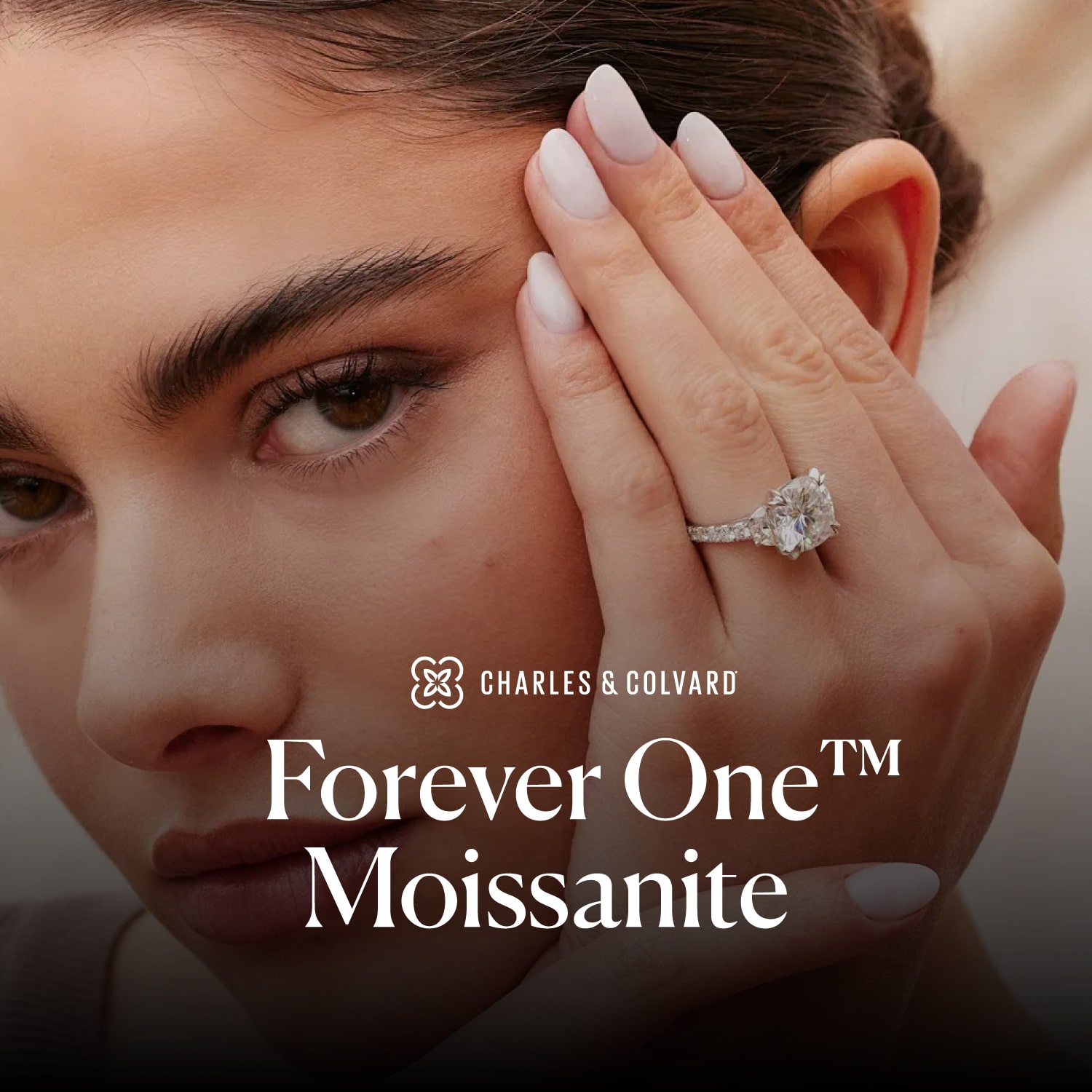
Forever One™ is Charles & Colvard’s signature moissanite line, offering the highest quality stones they produce. Known for its exceptional brilliance, clarity, and color, Forever One moissanite is available in both colorless (D–F) and near-colorless (G–H–I) options. It’s a popular choice for those seeking a luxurious look without the diamond price tag—crafted with precision and designed to last a lifetime.
WHAT WE LOVE ABOUT IT:
- Premium-grade moissanite with outstanding fire and brilliance.
- Available in a wide variety of shapes and carat sizes.
- Ethically sourced and lab-grown in the USA.
- Comes with a certificate of authenticity and limited lifetime warranty.
- Colorless (D–F) options rival top-tier diamonds in appearance.
- Significantly more affordable than natural or lab-grown diamonds.
- Ideal for engagement rings, wedding sets, and heirloom-quality pieces.
- Resistant to scratching, breaking, and clouding over time.
- Sustainable and eco-conscious—no mining involved.
WHAT TO KNOW:
- Still carries a “moissanite stigma” for some buyers who expect a diamond.
- Slightly different sparkle than diamonds—more fire and rainbow flashes.
- Less resale value than natural diamonds or high-end lab-grown options.
We may earn a commission from affiliate links at no extra cost to you.